

Blog, Client-side Protection, LOGON Blog, Third-Party Risk, Threat Intelligence.
The Website Looked Fine. The Script Didn’t: What the Optimizely Supply Chain Attack Means for Third-Party Risk
LOGON BLOG
The Website Looked Fine. The Script Didn’t:
What the Optimizely Supply Chain Attack Means for Third-Party Risk
Author: Sandy Chu, LOGON Software Asia
Here’s a question worth sitting with. If one of the third-party scripts running on your website were quietly modified tonight, would you know before your customers did?
For more than a hundred major organisations, that question stopped being hypothetical this week.
On November 17, 2026, Optimizely confirmed that an unauthorised party had exploited a vulnerability in its Experimentation platform to insert malicious JavaScript into some customer projects. The injected code was delivered through Optimizely’s own legitimate delivery infrastructure—the same scripts organisations had already embedded on their pages for experimentation and personalisation.
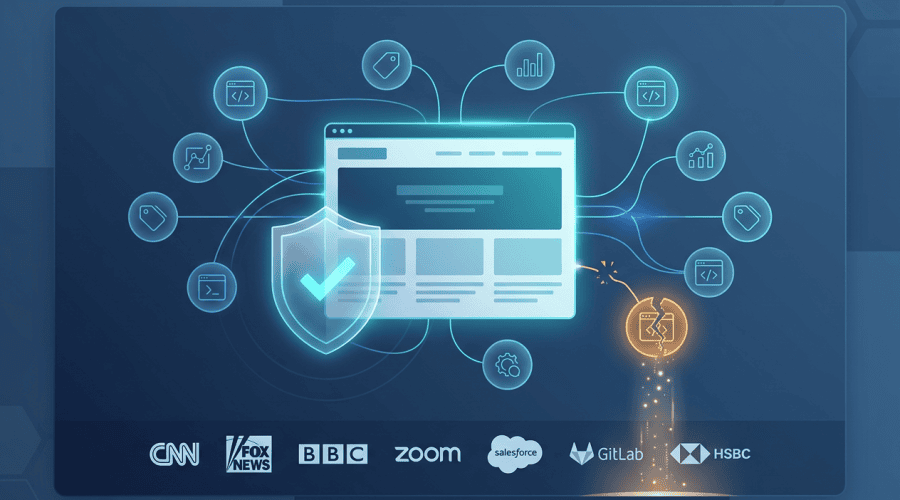
Websites associated with CNN, Fox News, the BBC, Zoom, Salesforce, GitLab and HSBC were among those identified in the investigation. By the time researchers had examined 1,611 files, they had identified 188 compromised snippets associated with 178 organisations.
And one of those snippets was cleaned, then reinfected during the incident—suggesting the attacker still held access at that stage. As late as 21:52 UTC on 16 November, one of the previously identified compromised snippets still contained malicious code.
This wasn’t a website defacement. The surrounding snippet could remain intact while the added code introduced a malicious dependency. A website can serve its own application correctly while a trusted external script changes what happens inside the visitor’s browser.
Do we know everything our pages load—including the dependencies our vendors introduce?
Why This Hits Asia Harder
Let’s be honest about the pace of things. AI-driven attacks have compressed breach timelines from weeks into hours—and that stings hardest in fast-moving digital hubs like Hong Kong, Singapore, and Tokyo. Ransomware-as-a-Service has turned what used to be specialist work into a mass-market criminal economy. Across Asia-Pacific, roughly 1 in 3 cyberattacks occur, and 7 in 10 small businesses reported a cyber incident in the past year.
Regulation is tightening too—and for organisations handling payment data in Asia, the stakes are already concrete. PCI DSS v4.0.1 requirements 6.4.3 and 11.6.1 place obligations on organisations around the scripts running on payment pages, and PDPO and other regional regimes expect organisations to understand who processes the data they hold.
This isn’t just a media industry story. It’s a third-party script governance problem wearing a marketing tool’s clothes—and most organisations across the region have far more scripts on their pages than anyone has approved.
What Makes This Attack So Instructive
There are three things about the OPTIMJACK campaign—as researchers have named it—that every security leader in Asia should be paying attention to.
First, the trust was the vector. Attackers inserted a loader into the platform’s Project JavaScript field. The resulting files continued to arrive through Optimizely’s legitimate delivery infrastructure. Nothing about the destination looked wrong. That’s materially different from replacing an entire website or redirecting visitors somewhere obviously unrelated.
Second, the payload was financial theft, not vandalism. Investigators described code intended to replace cryptocurrency wallet addresses and capture payment-form information. One is the gap between the address a user intends to approve and the one actually submitted. The other is data captured before the legitimate transaction finishes. A successful purchase does not necessarily demonstrate that the browser session was safe.
Third, the campaign reached beyond the browser. Analysts recovered a secondary loader delivered to iPhone and iPad browser profiles, with the mobile payloads identified as the Coruna and DarkSword exploit kits. The analysed code also included cookie collection and webpage screenshot functionality.
The investigation has expanded too. A separate report described malicious scripts delivered through four services—Optimizely, Kissmetrics, StorifyMe and minute-ly—with archived activity dating to 13 November, before the main Optimizely wave. Those other access paths remain unresolved, and should not be read as proof that all four providers were compromised the same way.
The Hard Part: Reconstructing the Exposure Window
Optimizely has fixed the vulnerability, removed the injected code, ended active sessions, revoked tokens, and reset access for affected accounts. That addresses the platform flaw going forward. It doesn’t tell you whether anyone was affected while the code was live.
Salesforce disabled Optimizely scripts as a precaution while investigating. Equifax stopped using Optimizely and found no evidence its systems were compromised. IKEA was still assessing potential effects. Reporting could not establish whether the malicious code succeeded in each case, and the financial picture remains uncertain—a figure of roughly $7,000 in receipts across identified wallets cannot be treated as the amount stolen, because some addresses had activity predating the incident.
There’s also a deception trap for investigators. A plain-text search for the primary malicious domain is insufficient, because some loader variants concealed the address using Base64 encoding, and another embedded the payload and attempted to execute it if the external delivery route was blocked.
And a useful discipline: separate three distinct questions. Was a malicious resource requested? Did the browser receive and execute it? Was sensitive information subsequently accessed or transmitted? Each needs its own evidence. That’s the difference between knowing you were exposed and knowing you were affected.
How LOGON can help
Here’s the thing. This attack doesn’t exploit a single weakness in one organisation. It exploits a shared assumption across hundreds of them: that a script from a trusted supplier is a safe script.
A layered defense doesn’t replace your vendor contracts. It gives your security team the evidence to enforce them.
1. Client-Side and Third-Party Script Governance: Knowing What Your Pages Actually Load
Investigations need to examine the complete set of resources a page loads—including dependencies introduced indirectly by consent managers, marketing tools, and other integrations. LOGON provides visibility into which first-party and third-party scripts run on your pages, which domains they contact, and which of them touch sensitive inputs—with particular scrutiny on checkout, authentication, and account-management pages. When you know every script by name and owner, a new or changed one stands out.
2. Content Security Policy and Browser Controls: Restricting What Can Execute
Properly configured policies can help prevent unauthorised scripts from running and provide useful violation reports. But policy design matters—allowing a trusted supplier’s domain does not verify the safety of every file that supplier delivers, and strict-dynamic can extend trust from an authorised script to the scripts it loads dynamically. LOGON helps you design, deploy, and monitor CSP and browser controls with those nuances in mind, and turn violation reports into an investigation trail.
3. SIEM Integration and Threat Intelligence: Building the Evidence Trail
When the question shifts from “are we patched?” to “who was exposed and when?”, you need logs you can reconstruct. LOGON integrates threat intelligence and SIEM to correlate DNS, proxy, and firewall records with browser-side monitoring and historical project files, so each suspicious resource gets its own evidence trail: where it originated, when it was served, and what executed after it loaded. Indicators of compromise are only useful if you can search for them—including the encoded variants.
4. Third-Party and Supply Chain Risk Visibility: Mapping the Dependency Chain
One external service created exposure across otherwise unrelated organisations. LOGON helps you map your third-party relationships, understand which vendors deliver code to your customer-facing pages, what each integration can reach, and whether that access is still justified. That includes the less obvious services—consent managers, analytics, personalisation—that are easy to forget and hard to audit.
Conclusion
The Optimizely incident isn’t just a media and retail story. It’s a reminder that your customer-facing attack surface is the sum of every script you load—not just the ones you wrote.
Patching your own systems answers “are we secure?” Governing third-party code and reconstructing browser exposure answers “were our customers safe, and would we know if they weren’t?” You need both, and you need them to run on the same evidence.
For CISOs and IT leaders across Asia—navigating rapid digital transformation, AI-accelerated threats, and a patchwork of regulations—script governance, continuous monitoring, browser controls, and supply chain visibility aren’t technical checkboxes anymore. They’re the difference between a website that looks fine and one that actually is.
Contact LOGON Software Asia today. Let’s talk about how we can support your organization’s security posture across Asia.
Comments are closed
Read Next:


